
Explained
Why is a basketball heavier than a soccer ball?
A regulation basketball weighs about 600 g (1.32 lb), while a soccer ball is about 430 g (15.2 oz). Official rules, geometry and air explain the 170 g (6 oz) gap.
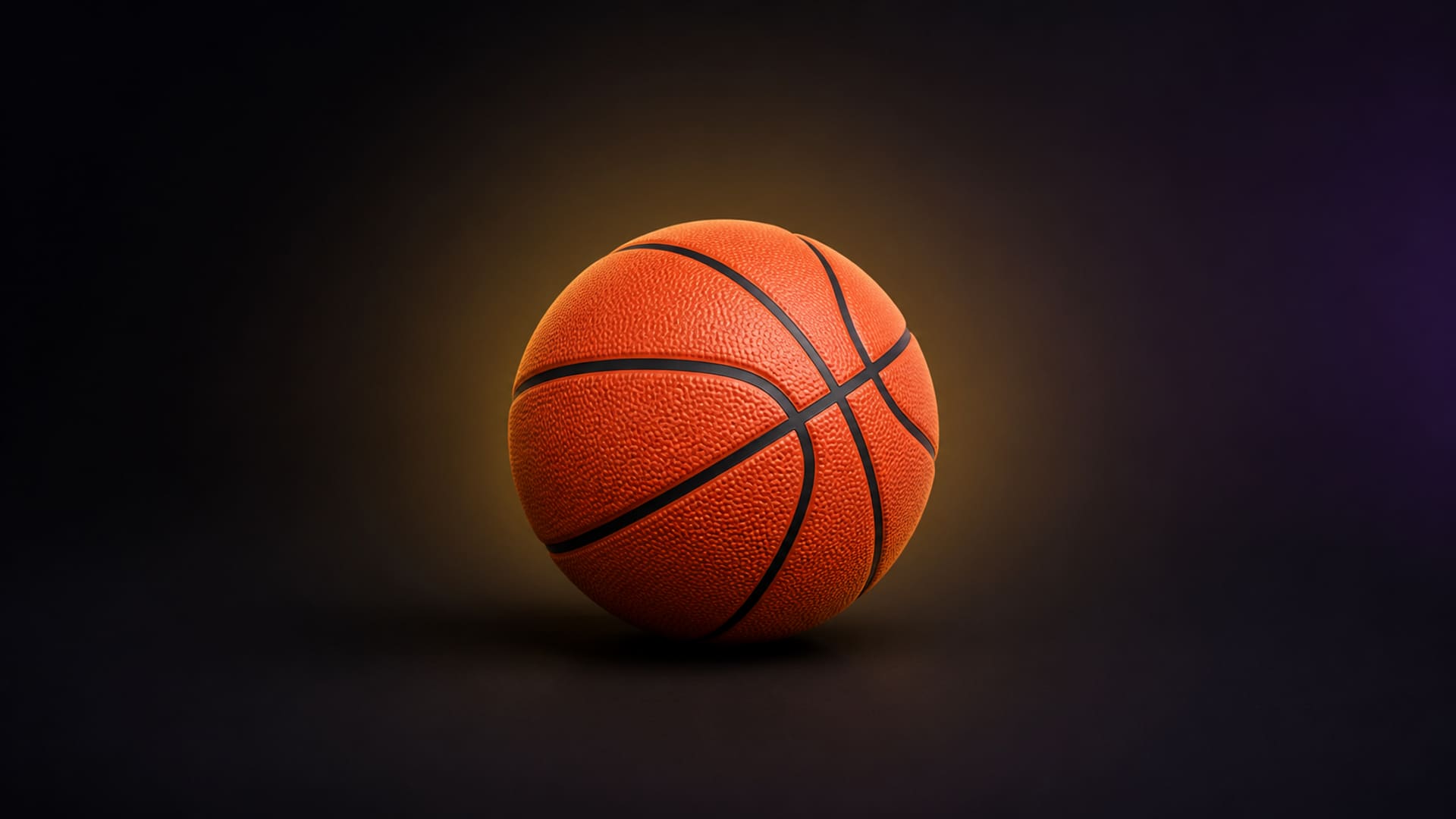
Put the two balls side by side and the result is easy to miss. Both are hollow, inflated and designed to be moved by people. Yet a men's size 7 basketball has an official range of 580–620 g (20.5–21.9 oz), while a match soccer ball must start between 410 and 450 g (14.5–15.9 oz).
The short answer is not simply 'more air.' The basketball is larger, has more surface to build and is regulated for a different kind of contact with the floor and the hand. The rules define the outcome; geometry and construction explain why reaching that outcome requires more material mass.
The official answer: 600 g (1.32 lb) versus 430 g (15.2 oz)
FIBA specifies 580–620 g (20.5–21.9 oz) for a men's size 7 basketball. IFAB Law 2 specifies 410–450 g (14.5–15.9 oz) for a soccer ball at the start of a match. How Heavy? uses the midpoint of each permitted range: 600 g (1.32 lb) and 430 g (15.2 oz). The resulting 170 g (6 oz) gap makes the basketball about 40 percent heavier, not merely a few percent heavier.
Sources: FIBA , The International Football Association Board
The hidden multiplier is surface area
The midpoint circumference is about 76 cm (29.9 in) for the basketball and 69 cm (27.2 in) for the soccer ball. Treating both as spheres, surface area grows with the square of circumference and volume with the cube. That gives the basketball about 21 percent more outer area and 34 percent more internal volume. More area means more cover, backing and structural material before differences in texture or seams are considered.
Sources: FIBA , The International Football Association Board
Why the extra air is not the main weight
NASA's ideal-gas relation connects pressure, volume, temperature and gas mass. At ordinary room conditions, the basketball's roughly 7.4-litre volume holds only about 9 g (0.32 oz) of air at atmospheric pressure; inflation adds only a few more grams. Even generous assumptions cannot turn the air into the measured 170 g (6 oz) difference. Pressure strongly changes firmness and bounce, but most of each ball's mass remains in its physical shell.
Sources: NASA Glenn Research Center , FIBA , The International Football Association Board
The rules ask the balls to behave differently
FIBA does not define a basketball by pressure alone: dropped from about 1.8 m (5.9 ft), it must rebound between 1.035 and 1.085 m (3.40–3.56 ft), and its surface must provide grip. FIFA's football programme tests weight, circumference, roundness, bounce, water absorption, pressure loss and shape retention. These are different performance briefs for different sports, so equal-looking spheres are not engineered toward equal mass.
Construction matters — but there is no single universal recipe
It is tempting to explain everything with a fixed layer count, but the official rules do not prescribe one universal build. FIBA allows leather or artificial, composite or synthetic leather for top-level balls and rubber at another equipment level; IFAB requires a suitable material, while FIFA certifies finished performance. The defensible conclusion is narrower: the larger basketball shell must meet grip, rebound and durability targets within 580–620 g (20.5–21.9 oz), so material and structure — not a mysterious pocket of heavy air — dominate the difference.
Sources: FIBA , The International Football Association Board , FIFA
The answer in one paragraph
A basketball is heavier because it is a larger shell built to a different rulebook. Geometry creates more area to construct, while grip, rebound and durability define how that material must perform. Air matters to play, but contributes too little mass to explain the gap. For a useful mental shortcut, remember the official midpoints: basketball 600 g (1.32 lb), soccer ball 430 g (15.2 oz). Their 170 g (6 oz) difference is the weight of a regulation ice hockey puck at the upper NHL limit.
Methodology & transparency
Rule ranges come from the current FIBA equipment rules and IFAB Law 2. Catalog values are transparent midpoints: (580 + 620) / 2 = 600 g (1.32 lb) and (410 + 450) / 2 = 430 g (15.2 oz). The 40 percent difference uses 430 g (15.2 oz) as the baseline.
Surface and volume comparisons approximate the balls as spheres using the midpoint circumferences. The air estimate applies NASA's ideal-gas relation at ordinary room conditions and is an order-of-magnitude check, not a measurement of a particular ball. Exact materials, pressure and mass vary by approved model within the rule limits.
Last updated:
Sources
- Official Basketball Rules 2024 — Basketball Equipment — FIBA
- Law 2 — The Ball — The International Football Association Board
- FIFA Quality Programme for Footballs — FIFA
- Equation of State — NASA Glenn Research Center
- NHL Official Rules 2025–2026 — Rule 13: Puck — National Hockey League