
Explained
How much would you weigh on other planets? The Moon, Mars and Jupiter, explained
On the Moon a 62 kg (137 lb) adult reads just 10.3 kg (22.7 lb) on a scale; on Jupiter, 146 kg (322 lb). Here is the one line of physics behind those numbers — and a calculator to try your own weight.
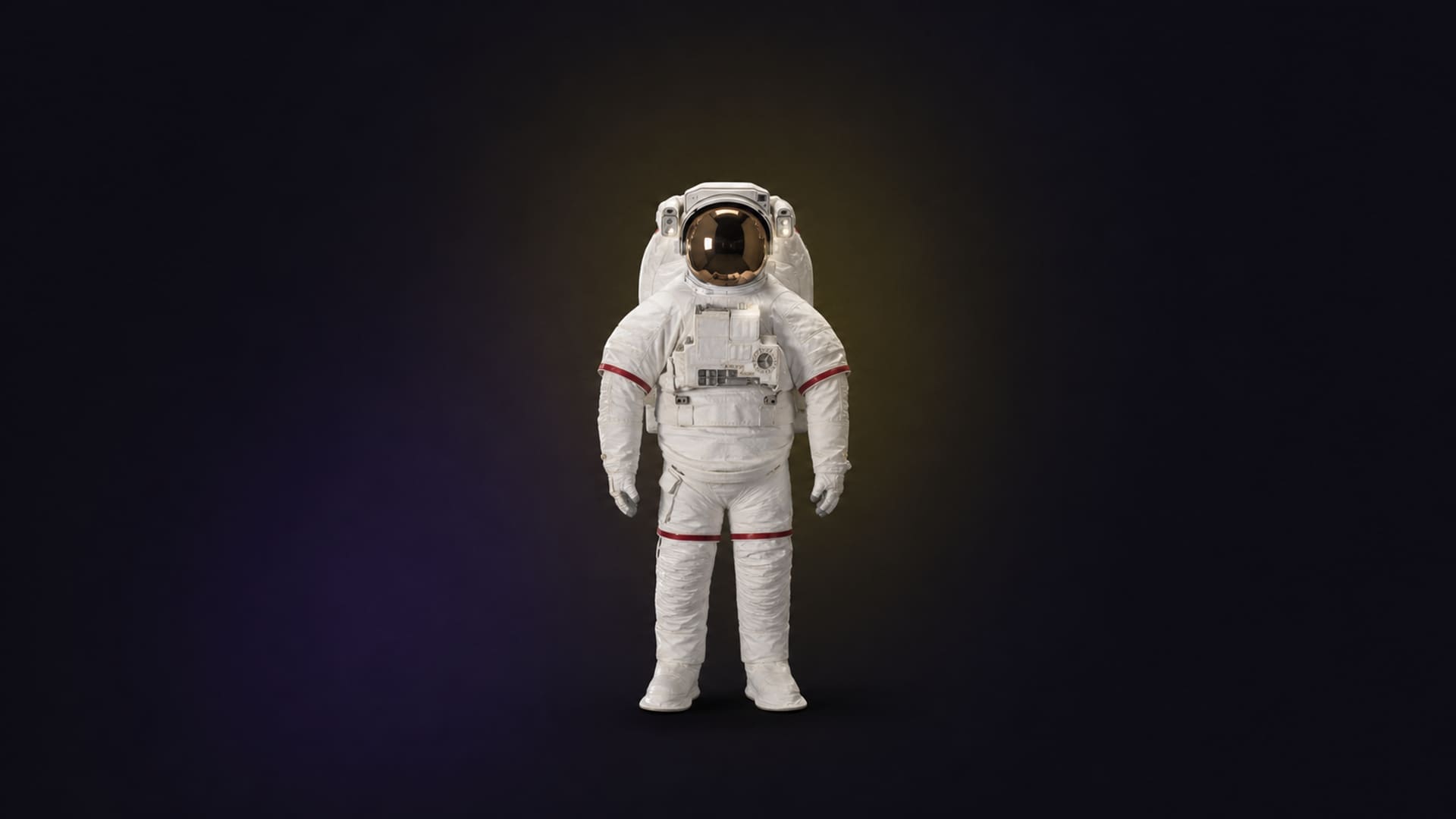
It sounds like a child's question, and like the best children's questions it quietly contains a whole physics course: how much would you weigh on the Moon? The answer — about a sixth of what your bathroom scale shows — is easy to look up. The interesting part is what the question does to the word 'weigh'. Nothing about you changes on the way to the Moon. You do not shrink, you do not lose an atom. And yet the scale reports a number six times smaller, and it is not lying.
This article walks through the numbers for the whole solar system — Moon, Mars, Jupiter, and the two absurd extremes, the Sun and Pluto — using NASA's own gravity values and a few anchors from our catalog. Along the way it untangles the two words that everyday language happily mixes up: mass and weight. And because reading about it is less fun than trying it, there is a calculator where you can enter any weight and watch it travel the solar system.
Try it yourself: the planet weight calculator →
A scale does not weigh you — it weighs a pull
Physics keeps two ideas apart that everyday language merges. Mass is how much matter you are made of, measured in kilograms, and it does not care where you are. Weight is the force with which a planet pulls on that mass — and a bathroom scale can only ever measure the force. On Earth the two move in lockstep, which is why we get away with the sloppy vocabulary. Leave Earth and they split: your mass stays fixed while the pull changes with every world you visit.
The most expensive demonstration of this ever built is in our catalog: NASA's EMU spacesuit weighs 127 kg (280 lb) on Earth — more than two adults, impossible to walk in. On the Moon, at 0.166 of Earth's gravity, the very same suit presses down like 21 kg (46 lb), roughly a packed holiday suitcase. Not one bolt of the suit changed on the flight over. The Apollo astronauts bounced across the surface inside hardware that would have pinned them to the ground at home.
Sources: NASA , NASA NSSDCA
The whole calculation is one line
Weight equals mass times gravitational acceleration: W = m · g. That is the entire machinery. NASA's planetary fact sheet lists g for every body as a multiple of Earth's — the Moon at 0.166, Mars at 0.379, Venus at 0.907 — so the recipe becomes: take any Earth weight, multiply by the factor, done. The global average adult of 62 kg (137 lb) reads 10.3 kg (22.7 lb) on a lunar scale, 23.5 kg (51.8 lb) on a Martian one, and a nearly familiar 56.2 kg (123.9 lb) on Venus.
The factors themselves hide the best surprise. Mercury, the smallest planet, and Mars, twice its diameter, pull almost identically: 0.378 versus 0.379. Surface gravity depends on mass and radius together — Mercury is small but dense with iron, Mars is bigger but lighter stuff, and the two effects cancel almost exactly. Size alone tells you nothing about pull, which is precisely the kind of trap your weight intuition falls into down here on Earth, too.
Sources: BMC Public Health , NASA NSSDCA
Jupiter multiplies you by 2.36 — and offers you no floor
Jupiter is where the childhood picture of the question breaks down. The number is real: NASA's fact sheet puts its gravity at 2.36 times Earth's, so our 62 kg (137 lb) adult would read 146 kg (322 lb). But there is nowhere to put the scale. Jupiter is a gas giant — below the cloud tops the atmosphere just gets denser and hotter for tens of thousands of kilometres, with no ground at any point you could stand on. The quoted gravity is defined at the visible cloud tops, the closest thing the planet has to a surface.
If the 2.36 looks smaller than the 2.5 you may have seen elsewhere, that is not an error but a definition. The fact sheet quotes equatorial values that include the effect of rotation, and Jupiter spins fast enough — one day lasts under ten hours — that the centrifugal effect at its equator noticeably reduces what a scale would read. Saturn plays the same trick even harder: despite having 95 times Earth's mass, its cloud-top reading is 0.916 — you would weigh slightly less at Saturn than at home. A planet's headline size and its handshake are different things.
Sources: NASA NSSDCA
The extremes: the Sun and Pluto
The Sun's surface gravity is 274 metres per second squared — about 28 times Earth's. Our 62 kg (137 lb) adult would read 1,736 kg (3,827 lb), the territory of a small car, and no human skeleton is built for that order of force. It is a strictly theoretical scale, of course: the 'surface' is 5,500-degree plasma. But the number explains something real — that pull is what holds eight planets on their leashes across billions of kilometres.
Pluto sits at the other end with a factor of 0.071 — one fourteenth of home. An average house cat of 4.5 kg (9.9 lb) would press on a Plutonian scale with about 320 g (11.3 oz), lighter than its own food bowl after dinner. You could lift the cat with a finger; the cat, for its part, could jump several metres straight up. Every weight you have an intuition for becomes wrong by more than an order of magnitude, in one direction or the other, depending on which rock you stand on.
Sources: NASA NSSDCA , NASA NSSDCA , Blue Cross
Try it with your own weight
Numbers about a statistical average adult only get you so far — the effect lands when it is your weight on the scale. Our planet weight calculator takes any weight, in kilograms or pounds, and shows the reading on all eight planets, the Moon, Pluto and the Sun, each with an everyday comparison so the number has something to hold on to. It uses exactly the NASA factors from this article, and it works just as well for your cat, your suitcase, or a bowling ball as it does for you.
And once the solar system has recalibrated your sense of what a number on a scale means, bring it home: the daily game asks the harder version of the same question. Not what you would weigh on Mars — but what a wheelbarrow, a penguin or a gold bar weighs right here, where your intuition has no excuse.
Sources: NASA NSSDCA
The answer in one paragraph
You weigh a sixth of your Earth reading on the Moon, a third on Mars and Mercury, about the same on Venus and Saturn, 2.36 times as much at Jupiter's cloud tops, 28 times as much on the Sun and a fourteenth on Pluto — and through all of it your mass never moves by a gram. A scale is an instrument for measuring a relationship, not a property. The number you see every morning is not a fact about you; it is a fact about you and a planet, jointly. You just happen to always be standing on the same one.
Methodology & transparency
All gravity factors come from NASA's NSSDCA Planetary Fact Sheet (ratio-to-Earth table). These are equatorial values that include the effect of each body's rotation, which is why Jupiter appears as 2.36 rather than the frequently quoted 2.5; for the gas giants and the Sun, which have no solid surface, the value applies at the visible cloud tops or photosphere. The Sun's factor of about 28 divides its surface gravity of 274 metres per second squared (Sun Fact Sheet) by Earth's 9.8. A 'scale reading' in this article means Earth weight multiplied by the factor — what a bathroom scale calibrated on Earth would display.
The example weights are catalog anchors: the global average adult of 62 kg (137 lb) from Walpole et al. (BMC Public Health 2012), NASA's EMU spacesuit at 127 kg (280 lb), and an average house cat at 4.5 kg (9.9 lb) from the Blue Cross weight guidance. Derived readings are simple multiplications, rounded to one decimal where it aids reading. Metric values come first, with an imperial equivalent in parentheses after every figure. The companion calculator at /tools/weight-on-other-planets uses these same factors with no additional assumptions.
Last updated:
Sources
- Planetary Fact Sheet — Ratio to Earth Values — NASA NSSDCA
- Sun Fact Sheet — NASA NSSDCA
- Spacewalk Spacesuit Basics — NASA
- The weight of nations: an estimation of adult human biomass — BMC Public Health
- Cat weight — how to tell if your cat is a healthy weight — Blue Cross
- Your Weight on Other Worlds — Exploratorium